
Carrboro Directory Holdings
The main historical shelf for Carrboro is the Hill's Chapel Hill directory series that explicitly includes Carrboro. The Carrboro cataloging pattern matters. A search limited to the town name can miss a volume described as Chapel Hill or Orange County. DigitalNC provides free records and linked scans for four located Hill's editions, while the UNC-Chapel Hill North Carolina Collection holds the related Carrboro material under call number c971.68 c46h. Each volume is a dated snapshot, not a full list of every person who lived in Carrboro that year.
| Collection | Years located | Where held | Access |
|---|---|---|---|
| Hill's Chapel Hill directory, including Carrboro | 1957, 1959, 1961, 1962 | DigitalNC and UNC North Carolina Collection | Free metadata records and linked scans |
| Chapel Hill directory records | 1957, 1959, plus Carrboro-inclusive 1961-62 volumes | DigitalNC, Internet Archive, library computers | Digital or library access |
| HeritageQuest city directories | Database-wide range not located | Orange County Public Library | Library subscription |
| North Carolina Year Book and Business Directory | 1902, 1908, 1922 examples | DigitalNC and UNC collection | Statewide directory, not a household street book |
The research did not locate a complete standalone Carrboro run or an official local year run for reverse directories. Search the Orange Library catalog, HeritageQuest, and UNC before assuming a missing Carrboro year was never printed. A Carrboro catalog record or scan can establish publication, but the printed page remains the evidence for a specific household.
Hill's Carrboro Directory Years
DigitalNC says its North Carolina City Directories collection digitized nearly every directory it could locate from before 1968. The Carrboro material is concentrated, rather than continuous: Hill Directory Co. editions have been located for 1957, 1959, 1961, and 1962. That Carrboro pattern makes a gap meaningful. A person absent in an unlocated edition has not necessarily left town, and a person present in a listed edition may have moved before the book reached print.
- 1957: Hill's Chapel Hill directory including Carrboro is catalogued by DigitalNC and linked to an Internet Archive scan.
- 1959: another Hill's edition is available through DigitalNC with the same UNC collection connection.
- 1961: the Carrboro-inclusive Hill's sequence continues in the digitized collection.
- 1962: a further digitized Hill's record closes the located group, not the history of Carrboro households.
For a Carrboro directory record and scan, use DigitalNC's 1959 Hill's Chapel Hill directory record. Its metadata identifies the Hill Directory Co., the UNC contributor, and the linked Internet Archive object. Compare the title page and introductory material in the chosen edition before transcribing a name.
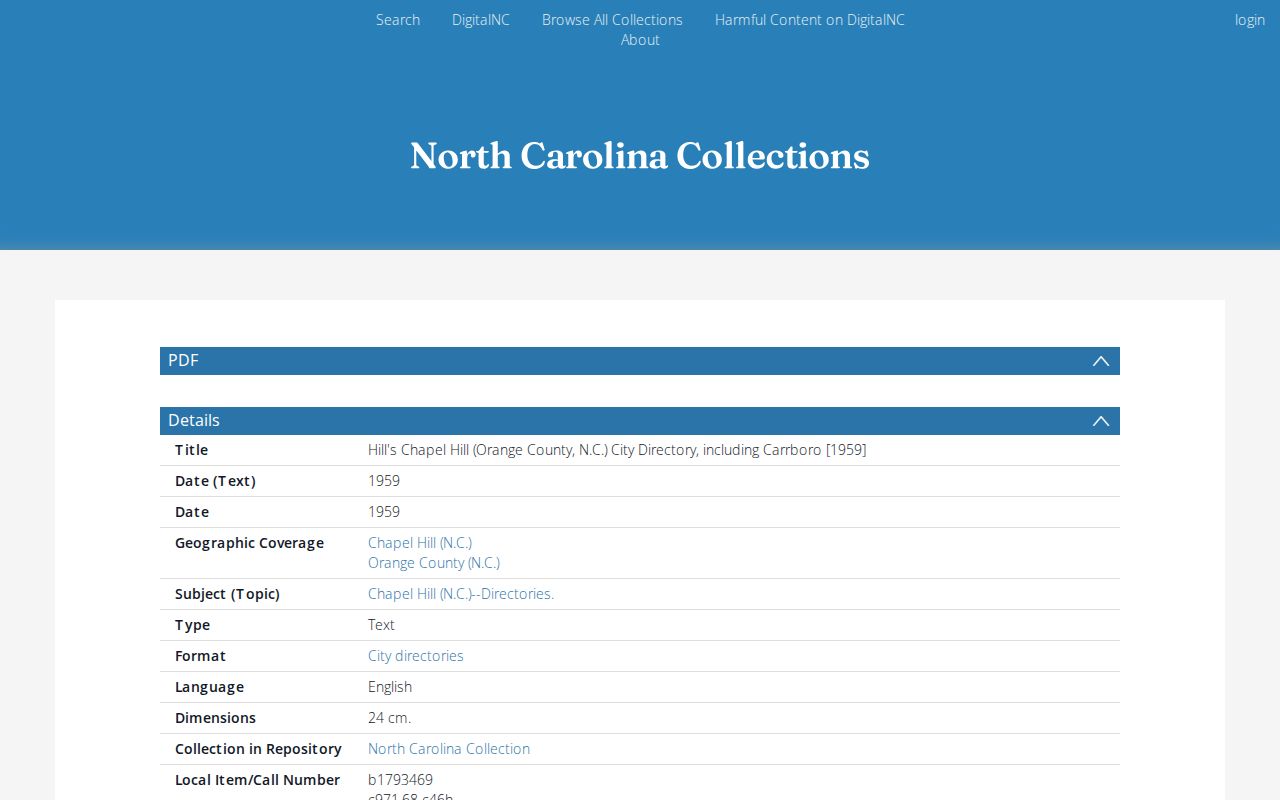
The record view is a useful starting point because it confirms the edition and collection context before a researcher turns to individual pages.
Carrboro City Directory Library Access
The Rebecca B. Wall Local History Collection at Orange County Public Library is the practical fallback when a digitized Carrboro directory has a gap. Its Main Library location is 137 W. Margaret Lane in Hillsborough. The Southern Branch at 203 S. Greensboro Street is the closer Carrboro branch, though the official description places the local-history room at the Main Library. Both list Monday through Thursday hours of 9 to 7, Friday and Saturday hours of 9 to 6, and Sunday hours of noon to 6.
Library access is broader than a row of directory volumes. The collection offers county newspaper microfilm, deed and will material, census microfilm, HeritageQuest, and Ancestry Library Edition on public computers. The Local History Liaison offers technical and research help most Mondays from noon to 3 p.m. Bring the Carrboro spelling variants, year, and address already found. Ask staff to check the catalog or a database rather than guessing that a nearby Chapel Hill listing excludes Carrboro.
Orange County Public Library's local-history page documents the collection, its databases, and its help route.
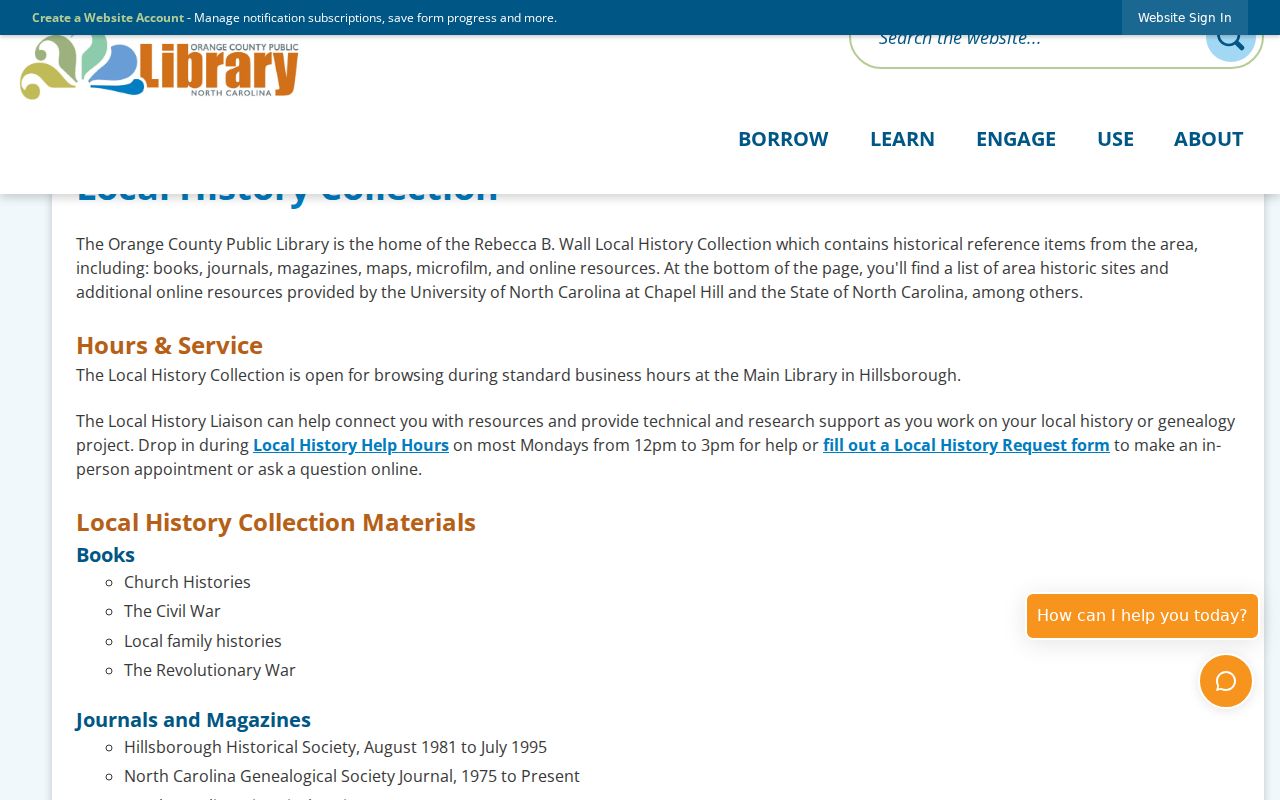
The library page supports an in-person fallback when a Carrboro directory scan is incomplete, hard to read, or absent from the web.
Note: Library access policies and database availability can change, so confirm current hours and remote-access rules before making a special trip.
Reading Carrboro Directory Entries
A Carrboro Hill's entry normally begins with a surname and given name or initials. It may add a spouse in parentheses, occupation or business affiliation, residence address, and sometimes a telephone reference. Those fields help separate people who share a surname in Carrboro. They are clues, however, not proof of title, family relationship, or continuous residence. Use the spelling on the page, then test middle initials, spouse names, and addresses in nearby editions.
| Alphabetical headword | Surname with given name or initials, useful for exact and variant searches. |
|---|---|
| Household clue | A spouse may appear in parentheses or on a second line; widow or widower notation can supply a genealogy lead. |
| Occupation or affiliation | A trade, employer, or business reference can distinguish same-name Carrboro residents. |
| Residence | A street address, sometimes separate from a business address, ties the entry to map and deed research. |
| Telephone or status mark | Later editions may add a telephone reference or abbreviation; read the edition's key before interpreting it. |
- Criss-cross directory
- An address-first arrangement that lists entries by street or number when an edition includes one. No complete local run was located, so check the actual volume.
- Householder index
- A listing organized around the household name or address rather than a full census of all occupants.
- Abbreviation key
- The introductory explanation of the volume's shortened words and symbols. Photograph or note it before drawing conclusions from an entry.
Carrboro Names in Directory Searches
Town and street names shape the historical search. Carrboro began as a railroad-centered settlement around 1882, was incorporated as Venable in 1911, and was renamed Carrboro in 1913. A newspaper, deed, map, or older description may therefore use West End or Venable instead of Carrboro. Keep those aliases beside the modern term when searching catalog text and newspaper indexes.
Street names also need a date check. Phipps Street became Lavender Street effective January 30, 2024, and Carr Street became Braxton Foushee Street effective March 27, 2024. The town distinguishes honorary signs from official changes. A historical entry should be searched under the printed street name first, then compared with the town's current naming record and a parcel identifier if the goal is to follow the location forward.
Note: A changed town or street name can explain a failed catalog search, but it does not prove that two similarly named people are the same person.
Carrboro Directory Maps and Newspapers
Carrboro directories gain context when paired with the county's newspaper and map resources. The library documents county newspaper microfilm from 1820 to the present, and the NC Archives guide lists Chapel Hill and Orange County titles including Chapel Hill Weekly from 1927 to 1961. Search close to a dated Carrboro directory entry for a marriage notice, obituary, civic reference, or business notice. A newspaper can clarify a move or name variant that the directory alone leaves uncertain.
The Library of Congress 1925 Sanborn map record has 11 sheets and notes Carrboro. The Carrboro sheets show building materials, uses, streets, and block context. They do not name residents. Use a directory for the household lead, then use the map to test whether an address or business location fits the place described in that edition.
For county-history context, the Orange County Historical Museum is a free Hillsborough resource with public hours listed as Monday, Tuesday, Thursday, Friday, and Saturday from 11 to 4, Sunday from noon to 4, and Wednesday by appointment.
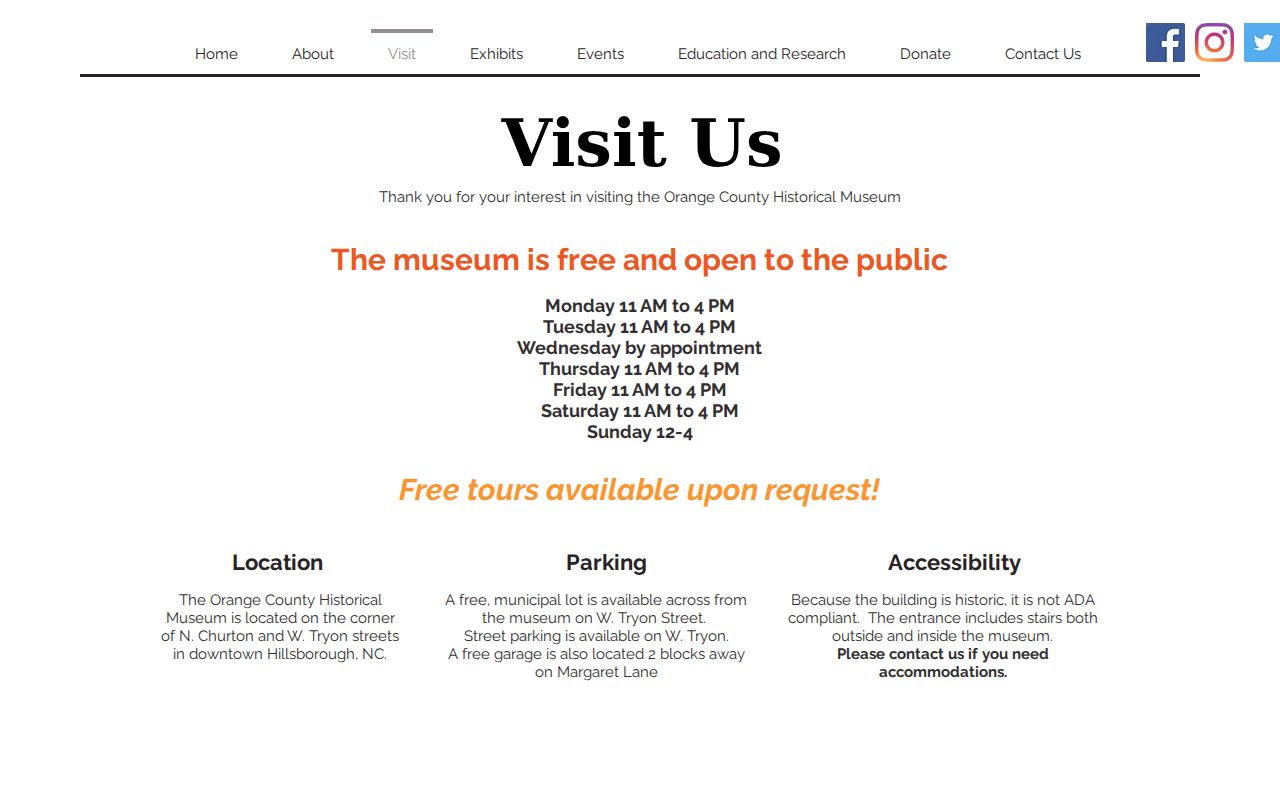
The museum is a useful place for local historical context while the library, UNC collections, and original public records supply the documentary trail.
Trace Carrboro Directory Households
Follow a Carrboro household in both directions from the best known year. The directory fills intervals between federal census releases, while the census offers household composition and enumeration geography. Federal census images are publicly released through 1950 under the 72-year rule. Dates can disagree because a directory was compiled at a different time and because a renter or boarder could be missed or move during the publication cycle.
- Find the full name in the alphabetical section and record spelling, initials, spouse, occupation, address, page, and edition.
- Check the next and previous located editions for the same surname and nearby address, noting a changed spouse, employer, or telephone reference.
- Use an address-first or reverse portion only if the actual edition includes one, then compare nearby names without assuming every occupant was printed.
- Pair the dated directory entries with the appropriate federal census release and retain the source date for each fact.
- Test a final lead against a deed, PIN record, map, newspaper, cemetery source, or probate file, depending on the question.
When a Carrboro household disappears, several explanations remain possible: a move, death, unlisted status, a spelling change, or a gap in the surviving sequence. The historical Carrboro volumes are one layer. For a present-day Carrboro street or parcel question, the Carrboro street directory uses current address-keyed county tools instead of treating an old listing as current.
Carrboro Oral Histories and Directories
Carrboro's Oral History Project began in 2015 with Town Manager's Office support and works with UNC's Southern Oral History Program. Completed Carrboro interviews are deposited with that program, which the town says has collected more than 5,000 interviews, including several connected directly to Carrboro. An interview can preserve a former neighborhood name, a mill-era reference, or context for a family already located in a directory.
Oral history is not a replacement for a dated Carrboro directory, deed, or certificate. Treat it as a source for search terms and local context. A recorded recollection can suggest where to look next, while the library, Archives, or county office should confirm the record itself. The same care matters for cemetery research, since Old Carrboro Cemetery includes unmarked graves and an absence from a register is not proof of absence.
Note: Keep oral-history observations separate from documented household facts until an original record confirms the connection.
Carrboro Directory Gaps and Fallbacks
When a Carrboro web scan does not answer the question, the next channel is the Main Library's local-history desk, followed by UNC's North Carolina Collection and the State Archives Discover Online Catalog. The library's documented microfilm reaches beyond city directories: deed index records begin in 1755, deed records in 1775, county newspapers in 1820, and court, will, marriage, and census series provide neighboring evidence. Carrboro historical material is often county-based because the county seat is Hillsborough, not Carrboro.
For a Carrboro collection query, identify the edition or date range, both Carrboro and Chapel Hill terms, Carrboro spelling variants, and the address if known. For an existing county-held record that is not online, Orange County also provides a public-record request channel under North Carolina Public Records Law, Chapter 132. Ask for an existing Carrboro record or index rather than a newly created household list. Current official copies and restricted records remain with the custodian.